From the BMW Historical Archives
| Production period: 1951 - 1954 |
| Power output: 24 PS bei 5800 U/min |
| Maximum speed (km/h): 135 |
| Displacement (ccm): 494 |
| Engine: flat-twin engine |
| Price: 2750 |
| Units: 18420 |
At the Amsterdam Show in February 1951, BMW had two motorcycle models with new engines on display: the 500cc R 51/3 and the 600cc R 67.
In contrast to the first post-war flat twin with its two chain-driven camshafts, there was now a single central camshaft driven by gearwheels from the crankshaft. The engines were handsome designs with smooth surfaces and one-piece valve covers. Placing the magneto and the generator behind the front cover made the engines more compact. The new Noris magneto ignition with automatic advance and retard enabled the engine to run particularly smoothly.
The frame retained the familiar suspension designs dating from 1938, with a telescopic fork at the front and plungers at the rear. The half-width 200-mm diameter brake hubs also came from the earlier models, but were uprated.
In their first test reports, the motorcycling press praised the results achieved by BMW's engineers, particularly the smoothness of the engines and the bikes' excellent handling. When entered for the Six Day Trial in 1951, the bikes came through this first sporting challenge with flying colours.
In 1952 the leading and trailing shoe brake was replaced by a two leading-shoe pattern, and from 1953 on rubber gaiters were fitted to the telescopic forms in place of the previous metal protective sleeves. The most important innovations for the 1954 model year were full-width hub brakes and new light-alloy wheel rims instead of the previous steel ones with their two-colour paint finish. The fishtail silencers were also replaced by a less complex cigar-shaped pattern.
Whereas the R 67 was conceived with sidecar enthusiasts in mind, the R 51/3 was aimed primarily at the sporting solo rider, though it also proved its worth on more lengthy tours and with a sidecar.
This bike
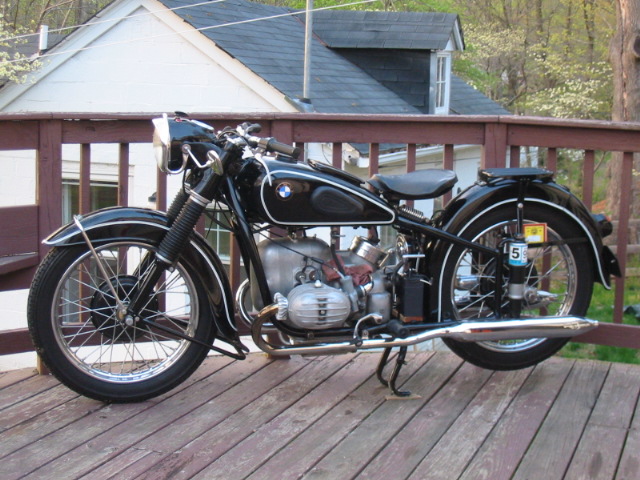
 #535237
was manufactured on May 13th, 1953 and delivered on July 14th, 1953 to the German BMW dealer Ernst Blass in Hamm.
At some point it ended up in England, then was taken to Greece by a man who painted it red. Lots of red.
#535237
was manufactured on May 13th, 1953 and delivered on July 14th, 1953 to the German BMW dealer Ernst Blass in Hamm.
At some point it ended up in England, then was taken to Greece by a man who painted it red. Lots of red.
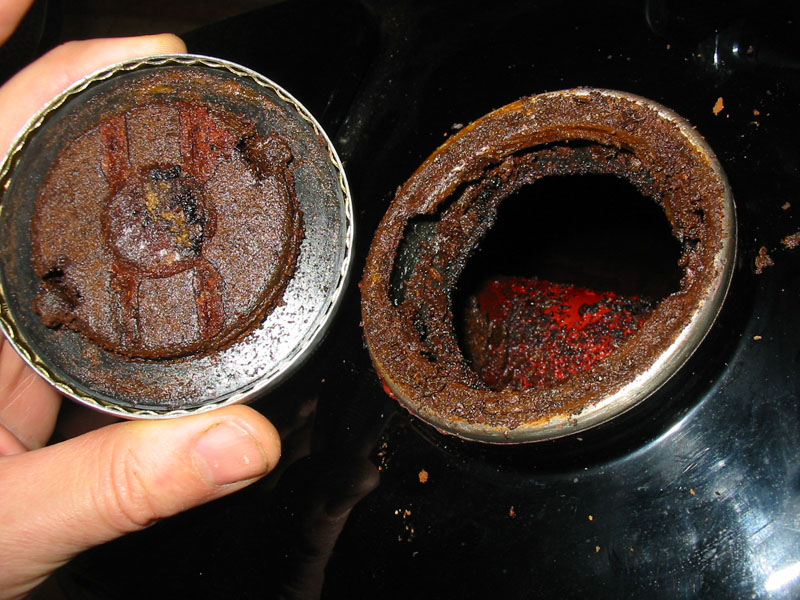
It was restored by the last owner but had hardly been ridden at all. The fuel cap was nearly corroded to the tank. I originally planned to completely strip and then re-coat the tank, but I'm settling for a good cleaning first. If it looks like I need to do more later on, I will. The exterior paint is so nice I don't want to risk damaging it with more chemicals than I need to use.
 The right-side carb had a stripped thread at the idle jet cover. There are different ways to deal with this but I thought I'd let Bing repair it. For $38 they installed a threaded brass insert which was done very nicely. Plus it motivated me to order a few other parts I needed from them.
Incorrect (or possibly so) on the bike are two items. The mufflers are cigar-style, and I understand that in 1953 the OEM mufflers were still fishtail. However, these probably work better and I like bikes to be quiet, so they will stay. The wheels, though, will need to be changed. The rims are chrome, whereas the originals were painted black with a gray center stripe. To me, this is one of the really cool styling cues of the old bikes and it will be restored. At some point, possibly when the rims were changed, the right-side spoke flange was stripped of its black paint and this will also be corrected.
The centerstand is worn out and is being replaced by one from - gasp! - Chang Jiang. It's the same part, and brand-new it's only $14. I had a customer with one and we had to order some parts, so it was added to the order.
The clutch has been upgraded to a diaphragm-spring design from a /2. The action is good but the flywheel is even heavier than before, although I didn't think this was possible. It needs to be lightened badly.
This bike was equipped with sidecar gearing (in the final drive) and sidecar springs. The gearing might stay for a while but the springs are going to be changed back to solo. It's way too stiff for solo use in the current form.
Cables
BMW specifies part 13 21 2 072 355 for throttle cables, but the fit may not be correct. The housing length I received (920mm) worked well but the free length (106mm) was too small. This bike needed about 120~125mm free length. Benchmark Works' web site indicates those cables having about 125mm. Who knows what you'll receive; the ones I ordered came from BMW.
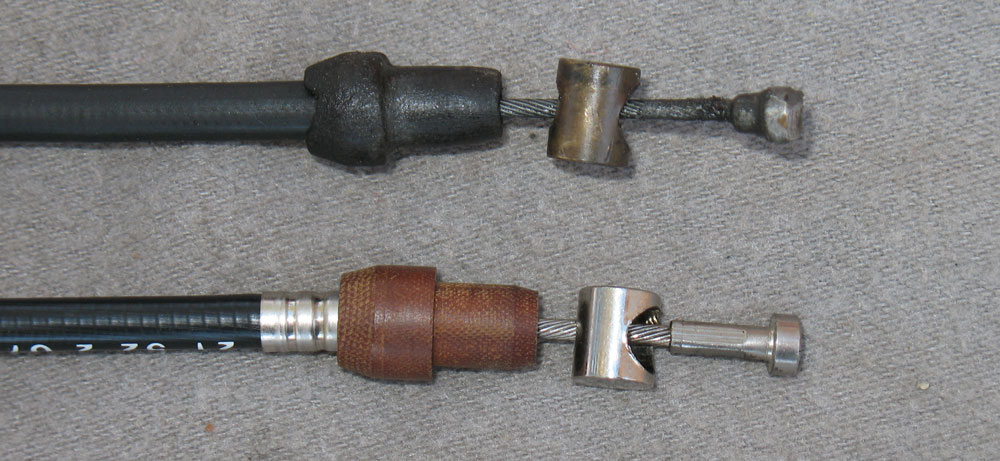
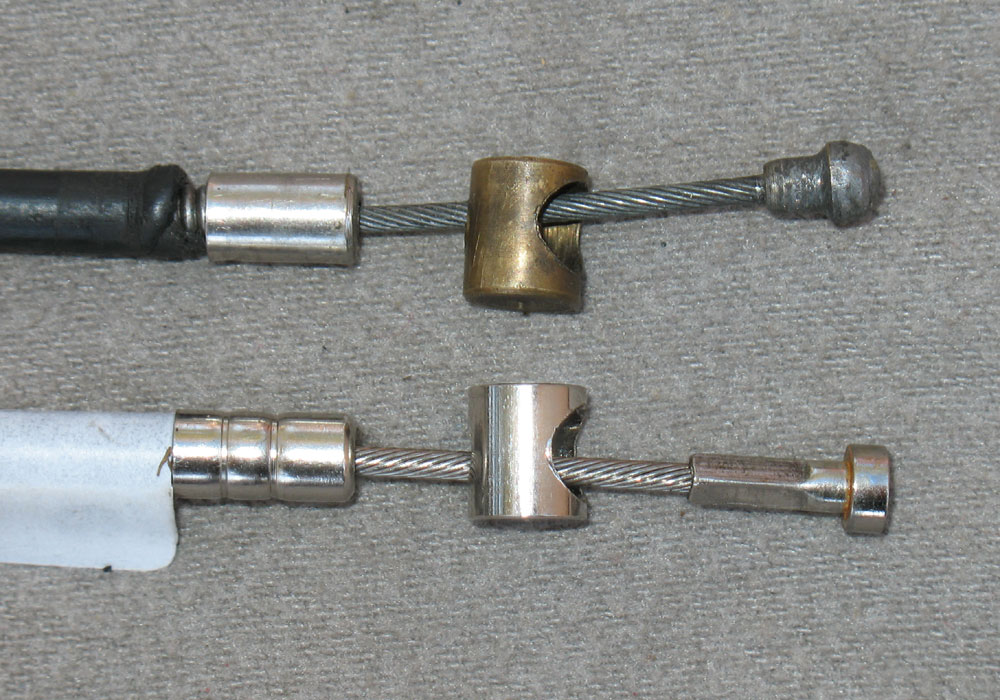
I finally got the new brake and clutch cables also. As expected they are different than the originals, but I have no idea if the originals were actually at their original length. The end lugs were larger - well, longer - but in all cases they fit between the ears of whatever they hooked through. Here are the new dimensions:
21 52 2 072 316 Clutch cable
 |
 |
|---|---|
| Top is similar but the crimp takes up extra space. | Same situation at the bottom. |
44.75" housing length
45.25" housing plus end bits, minimum
54" between cable end lugs
34 11 0 007 841 Brake cable, duplex
 |
 |
|---|---|
| Same with the top of the brake cable . | More extreme example at the bottom of the brake, but it didn't cause any problem. |
33.8" housing length
47.75" between cable end lugs
For my bike, the clutch cable could have been shorter overall, but the free length was good so the adjustment was normal.
The brake cable overall length was good but the free length was such that I have backed the adjuster out all the way to get the two brake arms parallel when the brakes are applied. I think I'll end up adjusting the arm position slightly so that the adjuster isn't out all the way. This is partially a bike problem and not a cable problem; if the free length had been any shorter it would have been difficult to install the cable. As it is, the cable just barely went on easily without having to pull the arms inward (I removed the hand lever and installed that with the installed cable as the last step) but I needed to go from 0% to 100% on the adjuster after that. It seems the root of this is that the rearward brake arm moves too far before the shoe hits the drum. With a slighly shorter inner cable length, I could compress the arms a bit to install the hand lever and then not need to max out the adjuster.
With two new cables up there, this thing will be a joy to ride. The front brake was nearly unusable for the RA rally trip due to the extreme cable friction. Now I'll be able to know that the bike has no brakes with much better modulation.
Other R51/3 pages
Other Vintage links
Vintage BMW Motorcycle Owners club
Duane Ausherman's website (lots of /2 and /5 stuff)
R51/3
