Oilhead 5-speed transmissions

There have been three different 5-speed transmissions used in the Oilheads. Some M93 and M94 transmissions are identified as such by the last three digits of the serial number, but M97 transmissions are not. The serial number is on the right side of the transmission, stamped vertically along the front of the case. When installed, it is roughly behind the right-side throttle body (shown in red in the photo to the left).
All three versions are dimensionally the same, and interchangeable, except the M93 had different internal gearing.
Different models
M93
These transmissions were used through 09/1993, so you'll only find them on the R1100RS. Several gears have a pronounced race-style undercut. Tapered roller bearings on the input shaft and an open barrel bearing on the rear of the cluster shaft. Replacement tapered and ball bearings are no longer available; M93 transmissions must be upgraded to the "clean bearing" design.
Since the gear ratios are specific to the M93, you will end up with shorter gearing if you replace one with an M94 or M97 and don't also change the final drive. Otherwise, the later versions will drop right in.
Primary reduction: 35:22 (1.591)
Gear ratios: 38:15 (2.53), 34:21 (1.619), 32:27 (1.185), 29:30 (0.967), 29:35 (0.829)
Final drive: 34:11 (3.091)
M94
These were used from 10/1993 through 03/1996. Undercuts eliminated, pointed shift spline used on first gear to aid engagement. Rubber O-rings were used between the gears and the cluster/output shafts, to quiet the clatter. Anecdotally, this made shifting worse. Towards the end of the M94 series, clean ball bearings were added to the input shaft starting with transmissions 10483DAF, 10776DAH, 12958DAK, 12650DAL, 12405DAG, 7864DAJ, 131DCF, and 101DCH. Clean bearings were used everywhere starting with transmissions [Dx]Q, R, S, T, U, V. Interchangeable with M97.
Primary reduction: 36:20 (1.8)
Gear ratios: 37:16 (2.313), 34:21 (1.619), 32:27 (1.185), 29:30 (.967), 29:36 (.806)
Final drive:
31:11 (2.818) for RS, 32:11 (2.909) for RT, 33:11 (3.0) for GS and R1100R, 37:11 (3.364) for R850R

M97
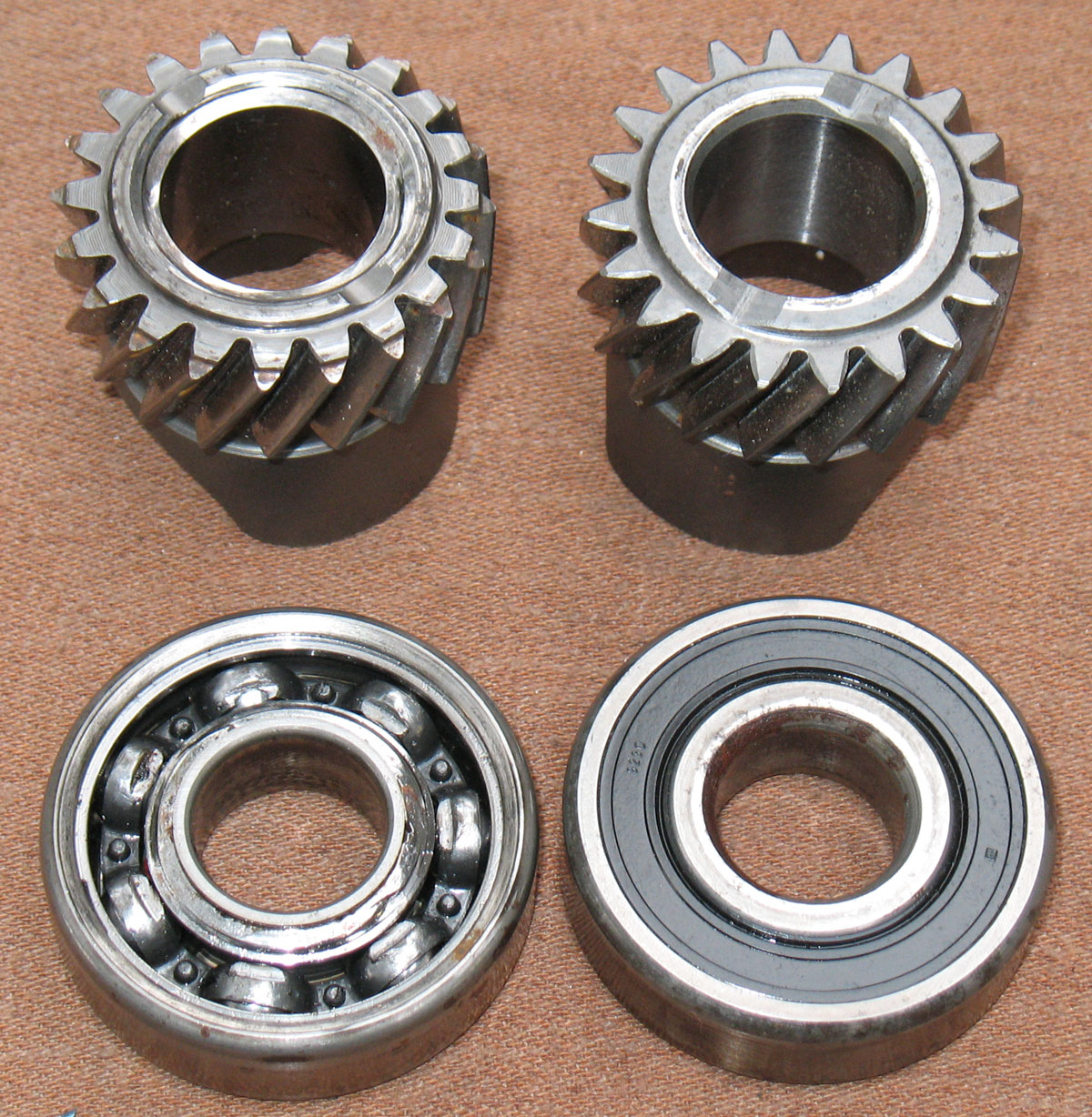
In 04/96 the input shaft was changed. All bearings were already sealed as of the last M94 units. Transmission suffixes started with E. Rubber O-rings were removed. The transmission housing is different due to the different input shaft and cluster shaft rear bearing. Interchangeable with M94.
The only problem that comes up with any regularity on the M97 is that the input shaft wears. Specifically, the input gear rubs against the rear bearing and they wear into each other (there isn't really enough contact area between them). Take a good look at the gear and bearing on the left; these are extreme cases showing how the gear and bearing have worn into each other. On the right are a gear and bearing showing a tiny trace of wear.
Eventually the gear oil becomes contaminated by this and comes out brown and burnt-smelling. There seems to be no reason why an M94 input shaft can't be installed in its place; the gear is the same and the assembly is cheaper and more reliable.
Details on this issue are here.
FAQ
No, I am not interested in talking you through rebuilding your transmission."Should I expect problems? "
Basically, I think there is no reason to expect problems with a gearbox that is working well. As with most of these things, the odds of a problem are still low, even when the design is considered troublesome. Small consolation for those experiencing problems, but true.
Keep an eye on the fluff sticking to the drain magnet when you change the oil. If you start seeing solid bits, you are approaching a problem. Shiny flakes are usually parts of the bearing races spalling off. Dull crumbs are probably bits of shift dogs which have been smashed loose. At some point the gearboxes will wear out even if they are not problematic, but that probably takes well over 100,000 miles.
"My bike 'skips' in third gear...
...almost like the ignition cuts out momentarily, or some gear is skipping a tooth." You need transmission work. This can happen to any gear, but usually second or third suffers first. People will try to tell you the shock coupling in the transmission is slipping from one position to the next... hogwash. It's not possible. What's happened is that the shift dogs have rounded off and a shift fork is bent. The gear is only engaged by the rounded part of the shift dogs, which let the gear slip off and bear against the fork. That in turn springs the gear back into engagement the next time the dogs line up a fraction of a revolution later. The problem can start with a bent shift fork (from dropping the bike on the shift lever, etc) or with rounded dogs (from too many missed shifts or half-shifts). It can also start from poor initial assembly of the transmission, whereby there was never enough shift dog engagement in a particular gear.
You can be certain you have this problem if the oil is an irridescent gold color when you drain it. The gold is the surface of the shift fork wearing away; normally there is absolutely no wear on the shift forks regardless of mileage. Thin slivers of metal that you find will be from the edges of the shift dogs.
Bottom line is, it needs to be repaired. The problem will get worse and you will damage the shift drum. A good rebuild brings M93 and M94 transmissions nearly to M97 spec. Nearly, meaning that the engagement dogs are straight and five out of six bearings are 'clean.' There will still be one open bearing and an M94 will still have O-rings, but neither difference is significant.
"My tranny is toast. What are my options?"
You have three real options:
1) Send the existing one out for rebuild. I fix these at my shop in Virginia (Virginia Motorrad). Seems to typically run $1000-$1300 depending on what needs to be done. Some dealers will rebuild them,
some won't. Many would rather sell you a factory refurb.
2) Factory refurb, over $3000 last time I looked, if available. Unfortunately, quality is an unknown and it's quite expensive. New transmissions are no longer available from BMW. M93 trannies are not available even as refurbs; replacement is not an option. M93 owners can use a later transmission but the gearing will be lower unless the final drive is changed also.
3) Buy a used tranny for $500 or so. Cheapest, but you may be buying an imminent problem. Not worth doing unless it's an M97 or rebuilt to updated specs.
"OK, I want you to fix it. What will it really cost?"
I can't give a firm quote without inspecting the gearbox, but you can build your own quote using your imagination. Prices are approximate! And there are other oddball parts which may need replacing; obviously I can't list every possibility.
| Item | App. cost |
Probability of need |
|---|---|---|
| Labor | $550 | yes |
| Shipping | $50> | yes |
| Gear repair | up to $950 | yes |
| Seals & bearings | $200 | yes |
| Shift fork | 158 | 90% |
| Another shift fork | $150 | 10% |
| Shift drum | $360 | 30% |
| Input shaft M93/M94* | $250 | You tell me |
| Total w/shipping | $1600 |
* If your M97 input shaft is bad, the gearbox is probably totalled since they are about $700. Shaft may be bad due to worn splines or internal damage.
"Can I replace my 5-speed transmission with a 6-speed?"
With enough money you probably can, but you will have to replace many other parts. The clutch splines are different, so you'd have to change the entire clutch including the flywheel. The rear subframe mounts differently, so you'll need a new rear subframe and then have to hope that your parts still bolt to that properly. The footpeg and footpeg mounts will be different, so you'll need them. The six-speed has a hydraulic clutch, meaning that you'll need to replace the hand control on the left side, and of course you'll want to change the right side to match it. The hand switches that fit those housings (which are different) use different connectors so you'd have to modify the wiring, and of course the throttle and choke cables are specific to the new controls as well. Additionally, the swingarm is different for that transmission, which requires a different rear shock as well, and you'll need a new driveshaft, too. You can keep the same motor, though.
Hopefully you've figured out the real answer by this point.
Terminology note:
BMW names the shafts Drive, Intermediate, and Output in the parts database, and Input, Idler, and Output in the repair manual.
Here are some production dates and transmission numbers I have collected over the years, to give an idea of when transmissions were produced.
0001622DB M93 4/93 bike0002275DB 4/93 bike
0002253DAC 4/93 bike
0002013DAC MY94 bike
0003256DAC 4/93 bike
0005163DAC 05/93
0005220DAC
0005659DAC 5/93 bike
0001680DB 6/93 RT
0006170DAC 6/93 bike
000667DAC 6/93 bike (missing a digit?)
0008084DAC 8/93 RSL
0002169DB 8/93 bike
0009256DBF 10/93 bike
0002528DAF M94 1/94 bike
0001023DAG M94 silver 2/94 bike
0003199DAF M94 3/94 bike
0004278DBF M94 8/94 bike (might be DBH)
0002363DAF M94 1/94 bike
0002343DAG M94 3/94 GS
0003606DAF M94 3/94
0004467DAF M94 10/94 RS
00038990AK M94 12/94
0004718DAF M94 12/94 bike
0002521DAK M94 11/94 bike
0004722DAG 12/94 GS
0004030DAK M94 1/95
0006700DAF M94 4/95 bike
0008136DAF 8/95 bike
0008420DAF black 8/95 bike
0008854DAF 9/95 bike
0009822DAF 12/95 bike
0007551DAG M94 4/95
0010379DAG 10/94
0011007DBF 8/93 RS (probably replacement)
0011111DBF replacement tranny, '96 or '97
0012095DAK silver, M94 trans
0004687DAG M94
0004704DAK 1/95 R
0000470DAH 9/95 bike
0003420DAN M94 8/94 bike
0003484DAJ black 8/95 bike
0010271DAG silver 9/95 bike
0010668DAG black, 10/95
0000270DAV 3/96 RT
===== Clean bearings ==========
0009578DAJ black 4/96 bike
0000379DAU 4/96 bike
0000653DAU 4/96 bike
0000187DAR black 5/96
xxxxxxxDAU, 5/96 bike
======M97==================
xxxxxxxEAE, silver, 98 bike
0006330EAF, black, 2/97
0003427EAE 2/97 GS
0017417EAF, black, 04/98 bike
0002174EAE, 9/97
0019314EAC, 1/99 R
0000748EAA, black, 1999 GS
0044069EAF, black, 2000 RT
Links
Interview with Getrag - interview by Motorcycle Online, translated by Kari Prager.

